Introduction:
The environment for creating mobile applications has undergone a massive structural shift. The old paradigm, where launching a mobile app required hiring separate, specialized teams to write entirely different codebases for iOS and Android over six to twelve months has been completely disrupted.
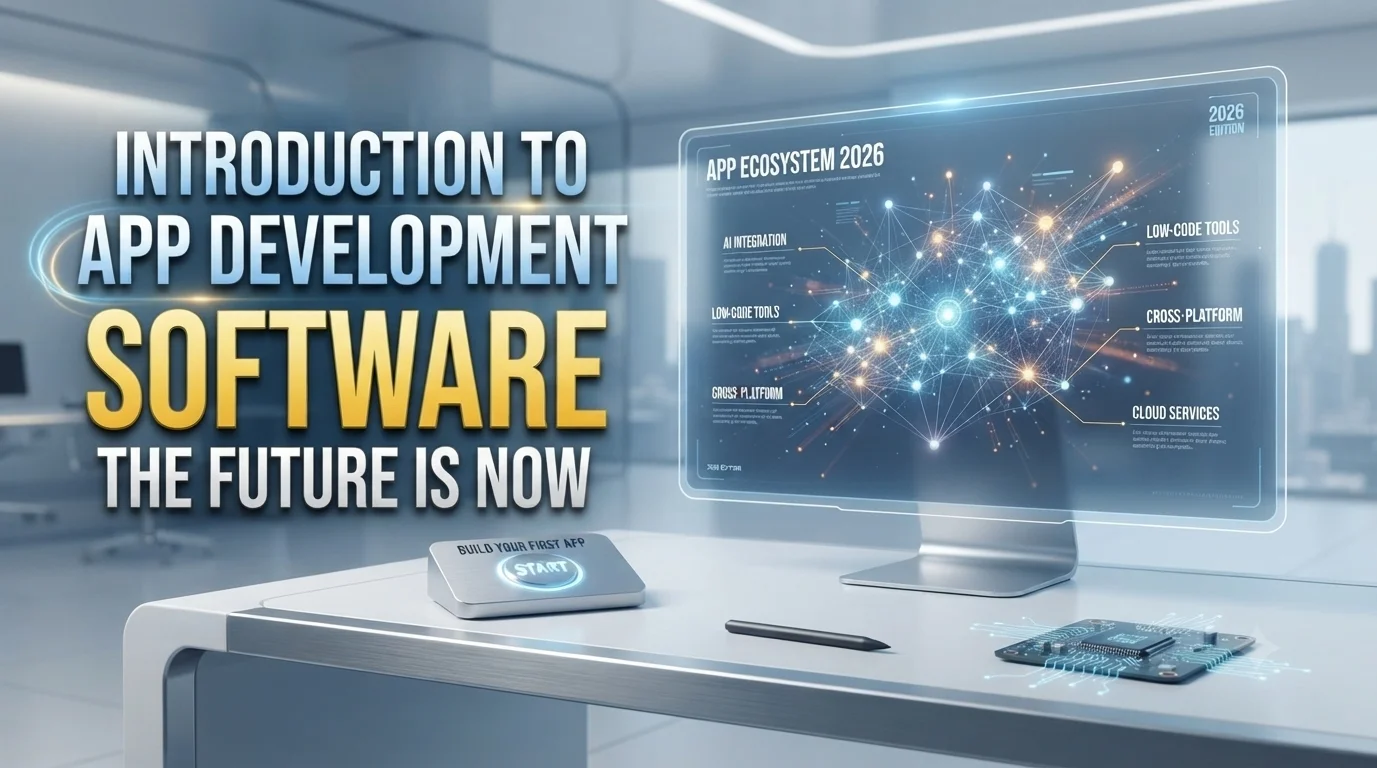
App development software has evolved into an ecosystem driven by generative AI intelligence, unified cross-platform frameworks, and production-ready visual builders. This evolution has democratized software creation, allowing solopreneurs, product managers, and enterprise squads to move from a conceptual layout to a live marketplace in a fraction of the time.
1. The Core Paradigm: AI-First and Generative Software
The most profound shift in app development software is the move away from basic syntax autocomplete toward fully integrated, multi-agent AI ecosystems. AI is no longer a helper extension; it is foundational to the development environment.
Natural Language App Engineering: Emerging modern builders allow users to describe an application’s purpose, features, and workflow using plain language. Behind the scenes, coordinated AI agents systematically construct the frontend code, map out database tables, generate backend logic, and configure API integrations simultaneously.
Continuous Repository Orchestration: For traditional coding setups, AI platforms run concurrently inside the development environment. They continuously scan code repositories, identify breaking dependency updates before they cause system errors, automate unit testing, and maintain strict parity between different platform deployment targets.
2. Cross-Platform Frameworks: The Mainstream Standard
The division between native iOS and Android development environments has narrowed significantly. Unified cross-platform software frameworks have matured to deliver near-native performance, becoming the preferred baseline for businesses and startups looking to optimize time-to-market.
Flutter & React Native: Backed by global tech ecosystems, these platforms allow engineering teams to write a single codebase that deploys fluidly to both major app stores. This completely eliminates the organizational friction of managing split product roadmaps and disparate “iOS versus Android” feature delays.
Kotlin Multiplatform (KMP): For applications that require high-performance hardware optimization, KMP has emerged as a powerful middle ground. It enables teams to write shared core business and data handling logic in a single environment while preserving the freedom to implement completely distinct, truly native user interfaces on the frontend.
3. Visual Builders and Low-Code Hit Enterprise Scale
The capability of low-code and no-code app development software has moved past simple, static prototyping. Data analytics firms project that a significant majority of new application infrastructure is built using advanced visual tools, which are now robust enough for heavy enterprise production environments.
Pixel-Perfect Backend Freedom: Modern low-code environments allow product teams to visually sketch advanced, responsive user experiences while maintaining total architectural freedom. Designers can directly plug their visual layouts into decoupled, cloud-based Backends-as-a-Service (BaaS) like Supabase or Firebase, or hook into legacy enterprise SQL databases.
Code Portability and No Vendor Lock-In: A major barrier of past visual platforms was technical confinement. Advanced development software solves this by providing full code-export capabilities, generating clean, production-grade source code (such as TypeScript, React, or Vue) that can be ejected into local code editors whenever a team needs to scale up custom manual features.
4. Native IDEs and First-Party Ecosystems
Despite the explosive rise of cross-platform and generative software, traditional native Integrated Development Environments (IDEs) remain critical for applications that lean heavily into advanced hardware capabilities, spatial computing, or direct operating system features.
Apple Xcode and SwiftUI: For software targeting Apple’s ecosystem, Xcode remains irreplaceable. It offers absolute, immediate access to native SDKs, such as augmented reality kits, device health sensors, and spatial computing environments the day they launch.
Android Studio and Jetpack Compose: Google’s flagship IDE provides deep device emulation, precise memory profiling tools, and strict optimization metrics necessary for deploying highly secure, heavily scaled applications across the massive footprint of global Android devices.
The Strategic Takeaway: The barrier to entry for building digital products has completely shifted from syntax execution to logic formulation. Because app development software can instantly handle the boilerplate code and cloud configuration, the success of an application rests entirely on product discovery, a deep understanding of user behavior, and the precise execution of business logic.
Conclusion:
In conclusion, app development software has officially transformed from a complex ecosystem of rigid syntax into an open, intent-driven environment. The convergence of conversational AI engineering, near-native cross-platform frameworks, and robust low-code enterprise engines has effectively democratized application creation.
By stripping away the traditional friction of managing separate codebases and configuring complex backend infrastructure, today’s development tools allow creators to refocus their energy where it matters most: delivering exceptional user experiences and solving real-world business problems.