Introduction:
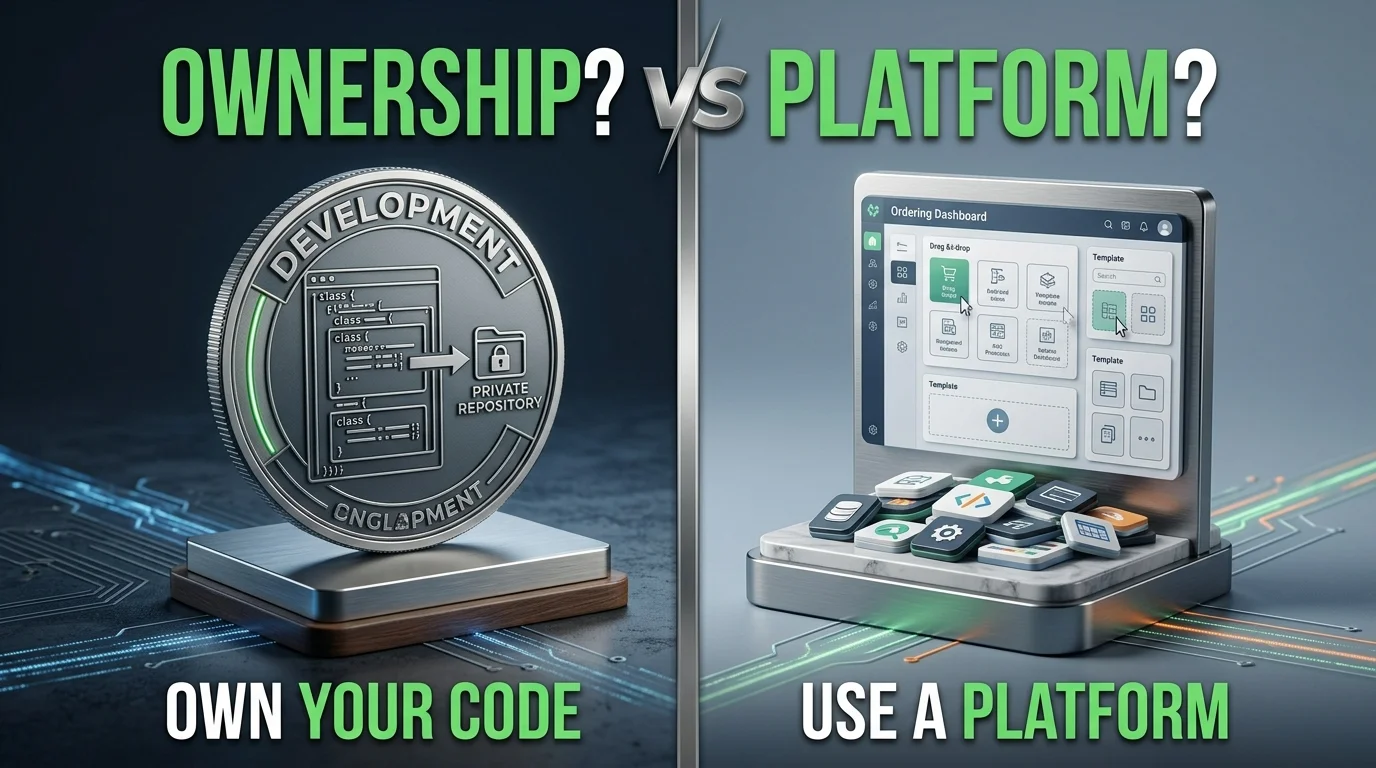
Choosing how to build a mobile application is one of the most critical foundational decisions a business can make. The debate generally centers on two opposing philosophies: owning your code (building from scratch using native or cross-platform frameworks like Flutter, React Native, or Swift/Kotlin) versus using a development platform (leveraging low-code, no-code, or Mobile Backend-as-a-Service platforms like FlutterFlow, Bubble, or Firebase wrappers).
Both approaches come with massive trade-offs. The right choice depends entirely on your budget, timeline, and how central the application is to your long-term business strategy.
Owning Your Code (Custom Development)
Owning your code means your development team writes the software line by line. You control the architecture, the hosting environment, and every byte of data that passes through the system.
The Advantages
Infinite Customization and Flexibility: You face zero technical ceilings. If an operating system supports a feature, like advanced background processing, complex Bluetooth syncing, or custom machine learning models which you can build it. You aren’t boxed in by a platform’s pre-made components.
True Intellectual Property (IP) Value: For tech startups and enterprises, the code is the value. Owning your codebase makes your company a technology holder, which is a massive asset for valuation, attracting venture capital, or potential acquisitions.
Seamless Migrations and Independence: Because you own the source code, you can move your hosting to any cloud provider (AWS, Google Cloud, Azure) or rewrite parts of the app whenever you want. You are never at the mercy of another company’s pricing changes or business stability.
The Drawbacks
High Initial and Ongoing Costs: Custom development requires specialized engineers (iOS, Android, backend, and QA). Beyond the hefty upfront launch costs, maintaining custom code requires ongoing investment to fix bugs and update dependencies when Apple and Google release new OS versions.
Slower Time-to-Market: Building everything from scratch—from user authentication to database pipelines—takes time. A fully custom app can take anywhere from several months to over a year to launch, delaying your user feedback loop.
Using a Development Platform (Low-Code / No-Code / App Builders)
Using a platform means you build your application within a managed ecosystem. These platforms abstract away complex infrastructure, allowing you to build apps visually or with minimal coding, using pre-built blocks for standard features.
The Advantages
Rapid Deployment: Platforms cut development time drastically—often by 50% to 70%. Because the backend architecture, security protocols, and user interface components are already built and tested by the platform, you can launch a functional application in weeks or even days.
Drastically Lower Barrier to Entry: You don’t need a massive team of elite engineers. A single developer, or even a non-technical founder, can build and iterate on a product. This severely reduces your initial financial risk.
Built-in Maintenance: The platform handle underlying infrastructure upgrades, server scaling, and basic compatibility updates with new mobile operating systems. This relieves your team of a massive maintenance burden.
The Drawbacks
The Vendor Lock-In Trap: This is the biggest risk. Many platforms do not allow you to export your source code. If you outgrow the platform, if they raise their subscription fees, or if the platform goes out of business, you cannot simply move your app. You will likely have to rebuild it entirely from scratch.
The “Technical Brick Wall”: Platforms are brilliant for standard use cases (marketplaces, content delivery, basic e-commerce). However, the moment your app requires a highly specific custom algorithm, unique hardware integrations, or heavy data processing, you will likely hit the platform’s limits.
Scalability and Performance Bottlenecks: While great for initial user bases, apps built on rigid platforms can suffer from sluggish performance or exorbitant scaling costs as database queries grow complex and user traffic spikes.
Conclusion:
Meanwhile, the decision for both AI development and mobile apps boils down to a classic trade-off: speed versus control.
Using a platform or outsourcing is ideal for launching quickly, validating ideas, and conserving upfront capital. However, if the technology is the core engine of your business or handles highly sensitive data, owning your code and building in-house capabilities is the only way to ensure long-term flexibility, security, and true intellectual property value. The smartest teams often use a hybrid approach the leveraging external platforms and vendors to get to market fast, while systematically building internal ownership for the long haul.