Introduction:
The choice between WordPress and Shopify in 2026 often comes down to a fundamental business decision: Do you want to own your infrastructure, or do you want to lease a high-performance engine?
As of May 2026, WordPress powers roughly 43% of the internet, while Shopify has grown to support over 5.6 million live stores. Both are enterprise-capable, but they serve very different operational styles.
1. Platform Philosophy: Open vs. Closed
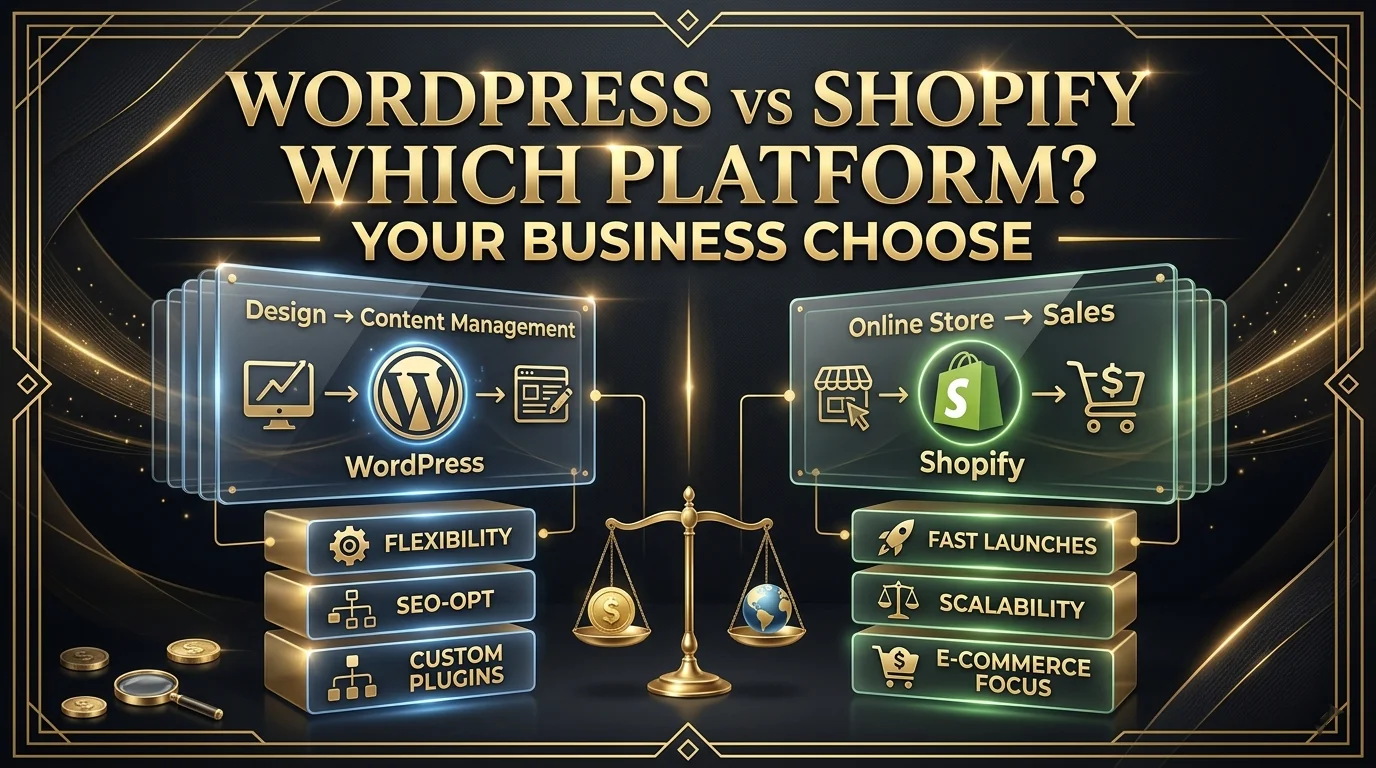
WordPress (The Open Ecosystem): WordPress is open-source. You have total “sovereignty” over your data and code. You can move your site to any host at any time. It is highly flexible but requires you to manage your own security, updates, and performance.
Shopify (The Managed Highway): Shopify is a “Software-as-a-Service” (SaaS) platform. It is a “closed” system, meaning you don’t have access to the core database, but in exchange, Shopify handles all the technical “heavy lifting”, hosting, PCI compliance, and security patches automatically.
2. SEO and Content Strategy
WordPress: For a business that relies heavily on organic search and content marketing, WordPress remains the gold standard. Its architecture allows for deep technical SEO adjustments, advanced schema markup, and superior long-form content management.
Shopify: While Shopify has improved its SEO tools significantly by 2026, it still has some structural rigidities (such as fixed URL paths like /products/ and /collections/). It is excellent for “fast” SEO wins but offers less precision for high-level technical strategies.
3. Cost Structures: Variable vs. Predictable
The WordPress “Hidden” Costs: WordPress itself is free, but a professional store requires paid hosting ($30–$300/mo), premium plugins, and often a developer’s retainer. Costs are variable and can spike if the site is attacked or needs a major update.
The Shopify “Subscription” Model: Shopify has a predictable monthly fee (starting around $29–$39 for basic plans). However, “app creep” is a real risk; many essential features for a growing store require monthly app subscriptions, and third-party transaction fees can eat into margins if you aren’t using Shopify Payments.
4. Scalability and Ease of Use
Shopify: If your goal is to launch a professional store in a single day, Shopify wins. It is designed for non-technical founders to manage inventory, shipping, and payments from a single, intuitive dashboard.
WordPress: Scaling a WordPress (WooCommerce) site requires more manual effort. You must ensure your hosting can handle traffic spikes (like Black Friday sales). While it offers “unlimited” customization, the learning curve for staff is much steeper.
5. International and Omnichannel Selling
Shopify: Excels at global selling. With “Shopify Markets,” you can handle multiple currencies, local taxes, and localized checkouts with a few clicks. It also integrates seamlessly with physical Point of Sale (POS) systems for businesses with retail locations.
WordPress: Can handle international sales through various plugins (like WPML), but it requires much more manual configuration to ensure tax compliance and currency conversion are accurate across different regions.
Conclusion:
The choice between WordPress and Shopify ultimately depends on whether you prioritize unlimited flexibility or operational simplicity. WordPress is the ideal choice for businesses that want total ownership and a robust content strategy, while Shopify is built for those who want to focus on selling without the burden of technical maintenance.
In the modern landscape, neither platform is “better” in a vacuum; rather, the “best” one is the one that aligns with your team’s technical capabilities and your long-term growth model. By choosing the platform that matches your operational style, you can spend less time troubleshooting your website and more time engaging with your customers.