Introduction:
Artificial intelligence has evolved from a niche experimental field into a foundational layer of modern technology, driving efficiency across every major sector of the global economy. By 2026, AI is no longer just a “feature” but an essential infrastructure for industries ranging from healthcare to heavy manufacturing.
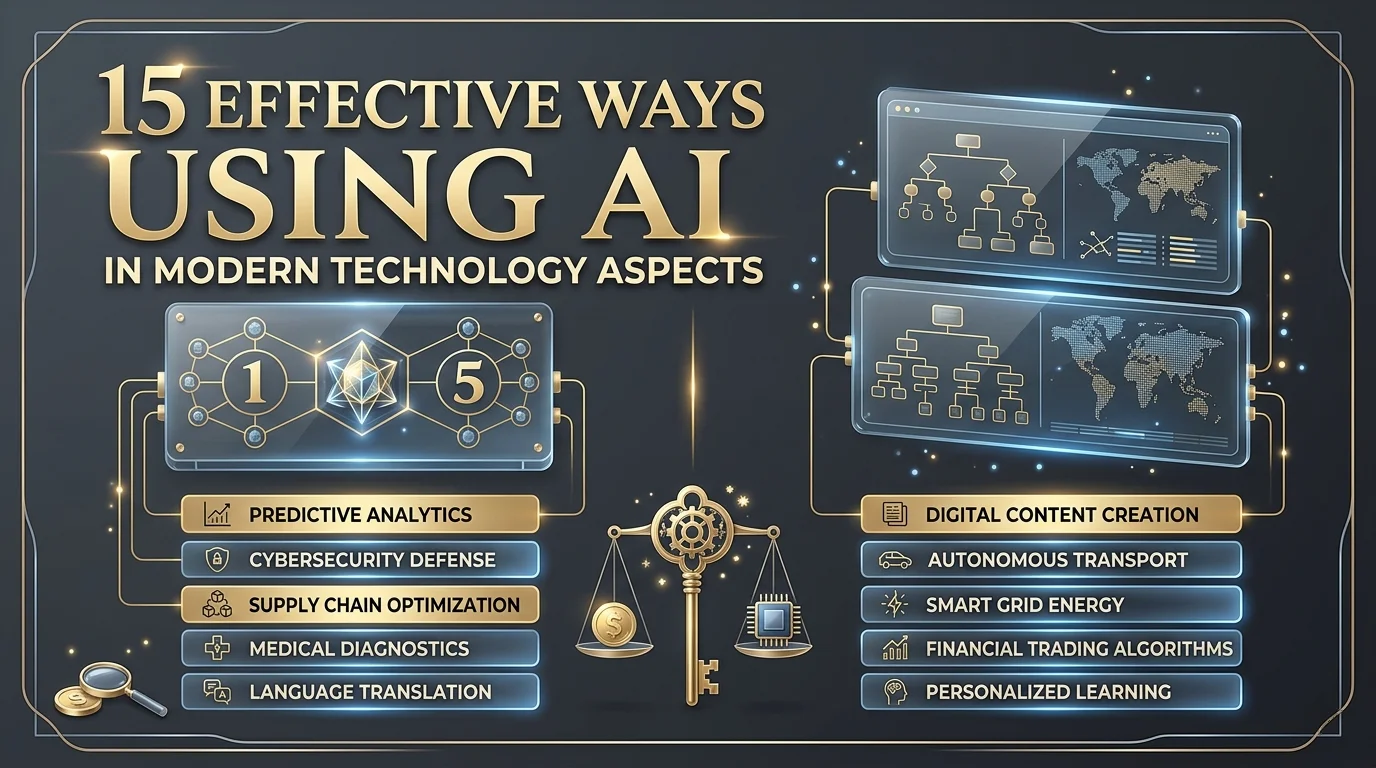
The following 15 applications highlight the most effective ways AI is integrated into modern technology:
1. Healthcare Diagnostics and Medical Imaging
AI algorithms are now capable of analyzing medical images, such as X-rays, MRIs, and CT scans with precision that often matches or exceeds human specialists. These systems can identify early-stage tumors or cardiovascular anomalies that might be invisible to the naked eye. Beyond imaging, AI models are outperforming doctors in management reasoning by significant margins when provided with comprehensive medical datasets (The BMJ, 2026).
2. Personalized Learning and Adaptive Education
In modern education, AI acts as a virtual tutor by tailoring instruction to the specific pace and needs of individual students. This includes adaptive assessment systems that adjust difficulty in real-time and simulation-based training for complex fields like neuroscience and rehabilitation sciences (Frontiers in Rehabilitation Sciences, 2026).
3. Predictive Maintenance in Manufacturing
Industrial operations use AI-driven automation to monitor equipment health. By analyzing sensor data, these systems predict potential hardware failures before they occur, reducing downtime and optimizing resource utilization throughout the production cycle.
4. Financial Fraud Detection and Risk Management
Financial institutions leverage machine learning to analyze millions of transactions in real-time. These models identify patterns indicative of fraudulent activity, neutralizing threats before significant financial damage occurs. AI also enhances credit risk assessments and supports high-frequency algorithmic trading.
5. Autonomous Vehicles and Smart Mobility
Transportation has been revolutionized by Deep Learning-based software that allows vehicles to navigate complex environments while maintaining lane discipline and safety headways (Abduljabbar et al., 2019). Beyond individual cars, AI optimizes entire public transit networks by prioritizing bus movements at traffic signals and providing real-time arrival predictions.
6. Climate Modeling and Carbon Control
AI-powered solutions are critical for achieving carbon neutrality. Machine learning models optimize renewable energy plants, improve carbon capture methods, and provide early warnings for extreme weather events through advanced remote sensing analysis (Mondal et al., 2024).
7. Cybersecurity and Threat Intelligence
Modern cyber defenses rely on AI to automate threat detection and incident response. AI-driven Intrusion Detection Systems (IDS) achieve high accuracy in flagging genuine threats while minimizing the false positives that typically overwhelm human security teams.
8. Logistics and Route Optimization
AI enhances the supply chain by providing demand forecasting and route planning. These systems analyze dynamic market conditions to ensure that goods are moved as efficiently as possible, minimizing fuel consumption and delivery times.
9. Natural Language Processing (NLP) in Citizen Services
Governments and corporations use AI to manage massive datasets and automate routine citizen inquiries. Common use cases include real-time translation, drafting documents, and routing requests to the appropriate departments, which drastically reduces administrative wait times.
10. Pediatric Development Insight Systems
In healthcare, AI is moving beyond basic diagnostics to become a longitudinal “insight engine” for pediatrics. These systems process multivariate data to identify early patterns in physical and cognitive development, allowing for evidence-based interventions in early childhood (PMC12860439, 2026).
11. E-commerce Recommendation Engines
Retailers use AI to analyze vast amounts of consumer behavior data. By predicting what a user might like to see next, these recommendation engines create personalized shopping experiences, though they must be carefully managed to avoid creating restrictive “filter bubbles.”
12. Smart Home Integration and IoT
AI serves as the brain for the Internet of Things (IoT), managing smart home devices through auditory and visual information. These systems learn user habits to automate energy consumption, security monitoring, and daily task management via voice assistants.
13. Programmable Finance and Blockchain
The convergence of AI and blockchain technology has enabled “programmable finance.” AI models automate compliance and streamline reimbursements in cross-border medical commerce, while stablecoins tailored for international transactions reduce friction in global payments (PMC12860439, 2026).
14. Creative Content Generation
AI has moved into the creative sphere, assisting in the generation of text, images, and music. While this raises ethical questions regarding authorship, it serves as a powerful tool for rapid prototyping and enhancing the workflows of designers and content creators.
15. Facial Recognition and Public Safety
Used extensively in airports and urban centers, facial recognition technology enhances security by identifying individuals in real-world environments. However, this application remains a point of intense discussion due to concerns regarding privacy and potential profiling errors.
Conclusion:
The integration of AI into modern technology marks a shift from simple automation to intelligent collaboration. By processing vast datasets with speed and precision, AI doesn’t just solve existing problems, it creates entirely new possibilities in fields like precision medicine, sustainable energy, and personalized learning.
Meanwhile, the effectiveness of these 15 applications depends on finding a balance between technological capability and ethical oversight. As these systems become more deeply embedded in our daily infrastructure, the focus is moving toward ensuring they remain transparent, secure, and beneficial for everyone involved.