Introduction:
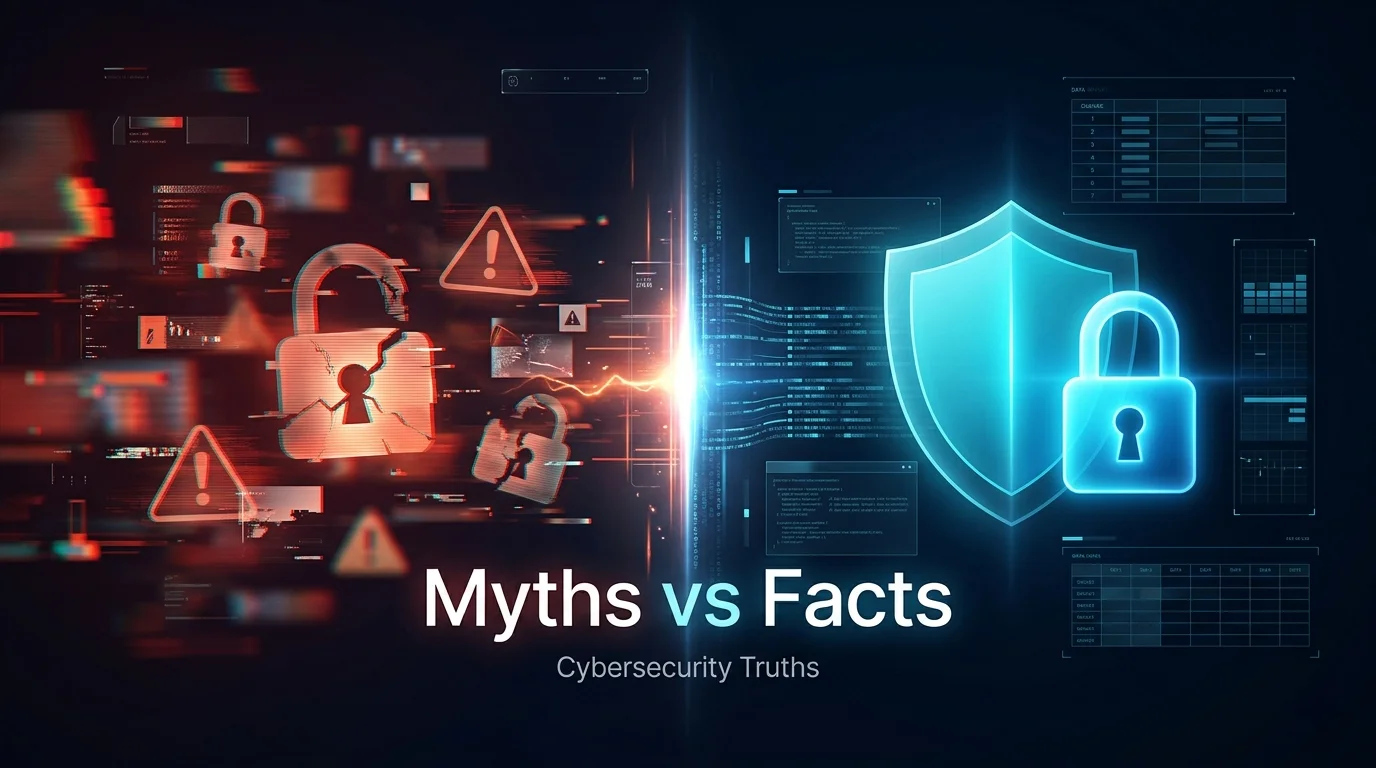
In the digital age, misinformation can be just as dangerous as a virus. Many business owners base their security strategies on outdated “common sense” that no longer applies to the modern threat landscape. By debunking these common cybersecurity myths, organizations can move toward a more grounded, effective defense.
Myth 1: “My business is too small to be a target.”
The Fact: Many small business owners believe hackers only go after “big fish” like banks or tech giants. In reality, cybercriminals often prefer smaller targets because they typically have weaker security. Modern attacks are frequently automated; bots scan the entire internet for vulnerabilities, regardless of company size. Furthermore, small businesses are often used as “stepping stones” to gain access to the larger corporations they partner with.
Myth 2: “Antivirus software and firewalls are all I need.”
The Fact: While antivirus and firewalls are essential foundational tools, they are no longer sufficient on their own. Today’s threats, such as sophisticated phishing and “fileless” malware, can often bypass traditional defenses.
A modern strategy requires a multi-layered approach, including Multi-Factor Authentication (MFA), endpoint detection, and, most importantly, employee training. Technology can protect the network, but it cannot stop a user from accidentally giving away their password.
Myth 3: “I’ll know immediately if my computer is infected.”
The Fact: This is perhaps the most dangerous myth. In the early days of the internet, a virus might freeze your screen or show pop-ups. Today, the most effective malware is silent. Cybercriminals want to remain undetected for as long as possible to steal data, monitor communications, or wait for the perfect moment to launch ransomware. Often, a system can be compromised for months before any outward symptoms appear.
Myth 4: “Cybersecurity is strictly an IT department issue.”
The Fact: Cybersecurity is a business-wide responsibility. Because the majority of successful breaches involve some form of human error, such as clicking a malicious link or using a weak password every employee is on the front lines. If the culture of the company doesn’t prioritize security, the best IT team in the world can’t fully protect the organization. It must be treated as a core part of operational risk management, not just a technical “to-do” list.
Myth 5: “Complicated passwords are enough to keep us safe.”
The Fact: While a complex password is better than a simple one, passwords alone are a weak point. Hackers use “brute force” tools that can guess millions of combinations a second, and “credential stuffing” uses passwords leaked from other site breaches to try and enter your system.
The fact is that Multi-Factor Authentication (MFA) is much more effective than a long password. Adding that second layer of verification like a code sent to a mobile device stops the vast majority of unauthorized access attempts.
Myth 6: “Our data is safe because it’s in the Cloud.”
The Fact: The cloud is generally very secure, but it operates on a shared responsibility model. While providers like Microsoft or Google secure the underlying infrastructure, the business is still responsible for securing the data within that infrastructure. If an employee uses a weak password or misconfigures a folder’s privacy settings, the “cloud” cannot prevent the resulting data leak.
Conclusion
Cybersecurity is not a “one-and-done” project; it is an ongoing process of education and adaptation. By moving past these myths, businesses can stop wasting resources on “theatre” and start investing in the practical, layered defenses that actually keep data safe.