Introduction:
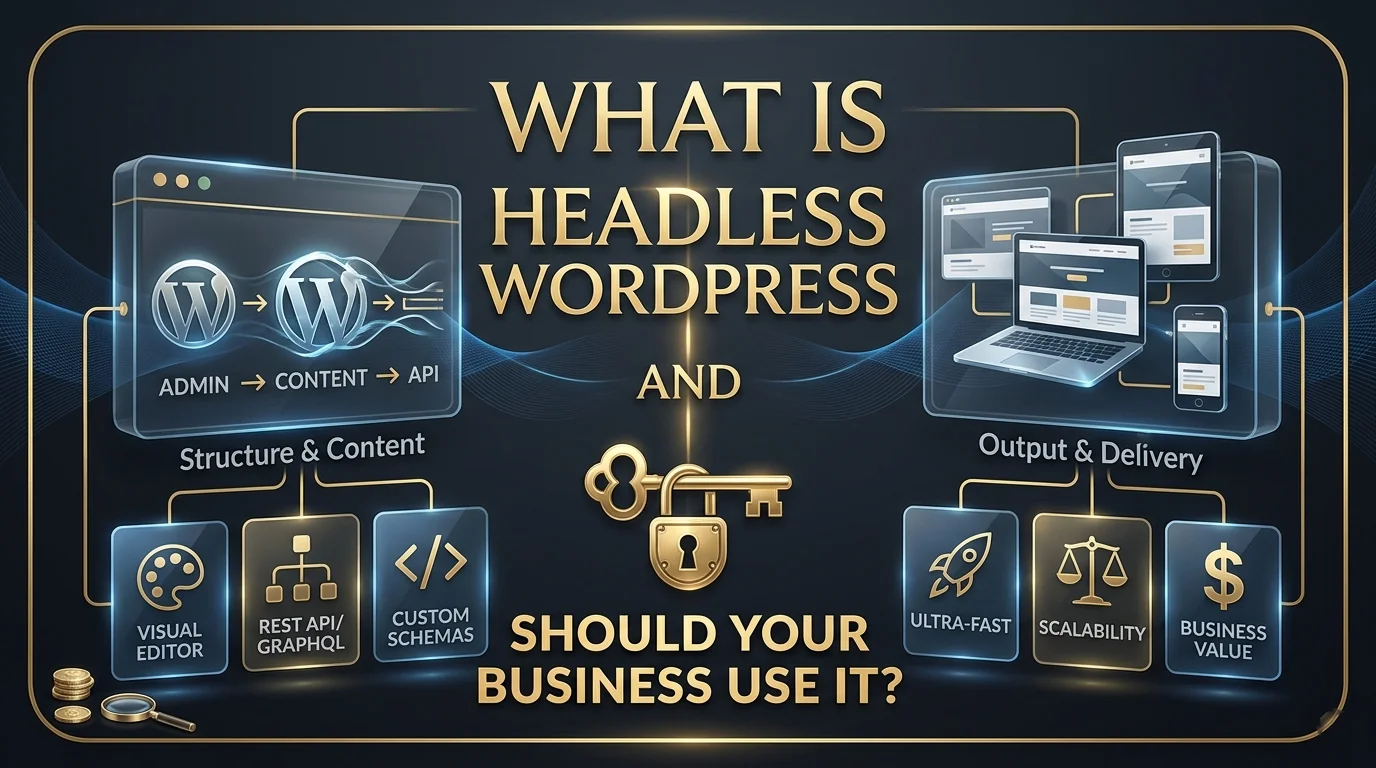
In the rapidly shifting web landscape of 2026, Headless WordPress has emerged as a high-performance alternative for businesses that find the traditional WordPress setup too restrictive. It represents a “decoupled” architectural approach that separates where content is managed from where it is displayed.
Here is a detailed discussion on how this technology works and whether it is the right move for your organization:
What is Headless WordPress?
In a “traditional” WordPress setup, the backend (where you write posts) and the frontend (what the user sees) are tightly linked. When a visitor clicks a page, WordPress uses its “Liquid-like” engine to pull data from the database and push it through a theme.
Headless WordPress “cuts the head off” this model. You still use the familiar WordPress dashboard to create and organize your content, but the frontend theme is completely removed. Instead, the content is delivered as raw data via a REST API or GraphQL. This data is then picked up by a separate, modern frontend framework, such as Next.js, React, or Vue.js—to display the website to the user.
Why Businesses are Moving to Headless
1. Extreme Performance and Speed
Traditional WordPress sites can become sluggish due to heavy themes and plugin bloat. In a headless setup, the frontend is often “statically generated.” This means pages are pre-built and served as lightweight HTML files, resulting in near-instant load times. For an SEO specialist, this is the “holy grail” for hitting perfect Core Web Vitals scores.
2. Future-Proof Omnichannel Delivery
Because the content is delivered via an API, it isn’t limited to a website. You can write a piece of content once in WordPress and have it appear simultaneously on your website, a mobile app, a smart wearable, or even a digital kiosk in a retail store. It turns WordPress into a centralized “content hub.”
3. Enhanced Security
One of the biggest risks with WordPress is that the login portal and backend are easily accessible via the frontend. In a headless architecture, the backend is hosted on a private or hidden server, while the frontend is a separate entity. This makes it significantly harder for hackers to find an entry point into your database.
4. Developer Freedom
Your design team is no longer limited by the constraints of WordPress themes or “builders.” They can use the latest web technologies to create highly interactive, “app-like” experiences that would be impossible or incredibly laggy in a traditional setup.
The Trade-offs: The “Hidden” Costs
Headless isn’t a magic bullet; it comes with significant overhead:
The Loss of “What You See Is What You Get” (WYSIWYG): Since the frontend is separate, you lose the ability to use live page builders like Elementor or Divi. Content editors have to trust the code to render the content correctly.
Double the Maintenance: You are now managing two separate systems, the WordPress backend and the custom frontend. This typically requires a higher budget for specialized developers.
Should Your Business Use It?
You SHOULD consider Headless WordPress if:
- An enterprise-level brand where site speed directly impacts millions in revenue.
- To push content to both a website and a mobile app.
- Should have a dedicated team of React or Next.js developers.
- Security is a top priority (e.g., in finance or healthcare).
You should AVOID Headless WordPress if:
- If there is a small to medium business with a limited technical budget.
- According to the marketing team relies on “drag-and-drop” builders to make daily site changes.
- A standard WordPress setup with a high-quality managed host is already meeting your performance goals.
Strategic Insight For a professional with an engineering background and a focus on SEO, Headless WordPress is an incredibly powerful tool. It allows you to maintain the user-friendly content management of WordPress while achieving the technical perfection required for top-tier search rankings.
Conclusion:
Headless WordPress represents the ultimate compromise between power and usability, allowing businesses to keep the world’s most popular content management system while adopting a cutting-edge frontend. It is a strategic move for brands that have outgrown the performance limits of traditional themes and require a faster, more secure, and omnichannel digital presence.
Meanwhile, the decision to go headless should be driven by technical necessity rather than trend. If your business requires “app-like” speed and the flexibility to push content to multiple platforms, headless is the clear winner. However, for those who value simplicity and ease of use for their marketing teams, the traditional WordPress model remains the most cost-effective and practical choice.