Introduction:
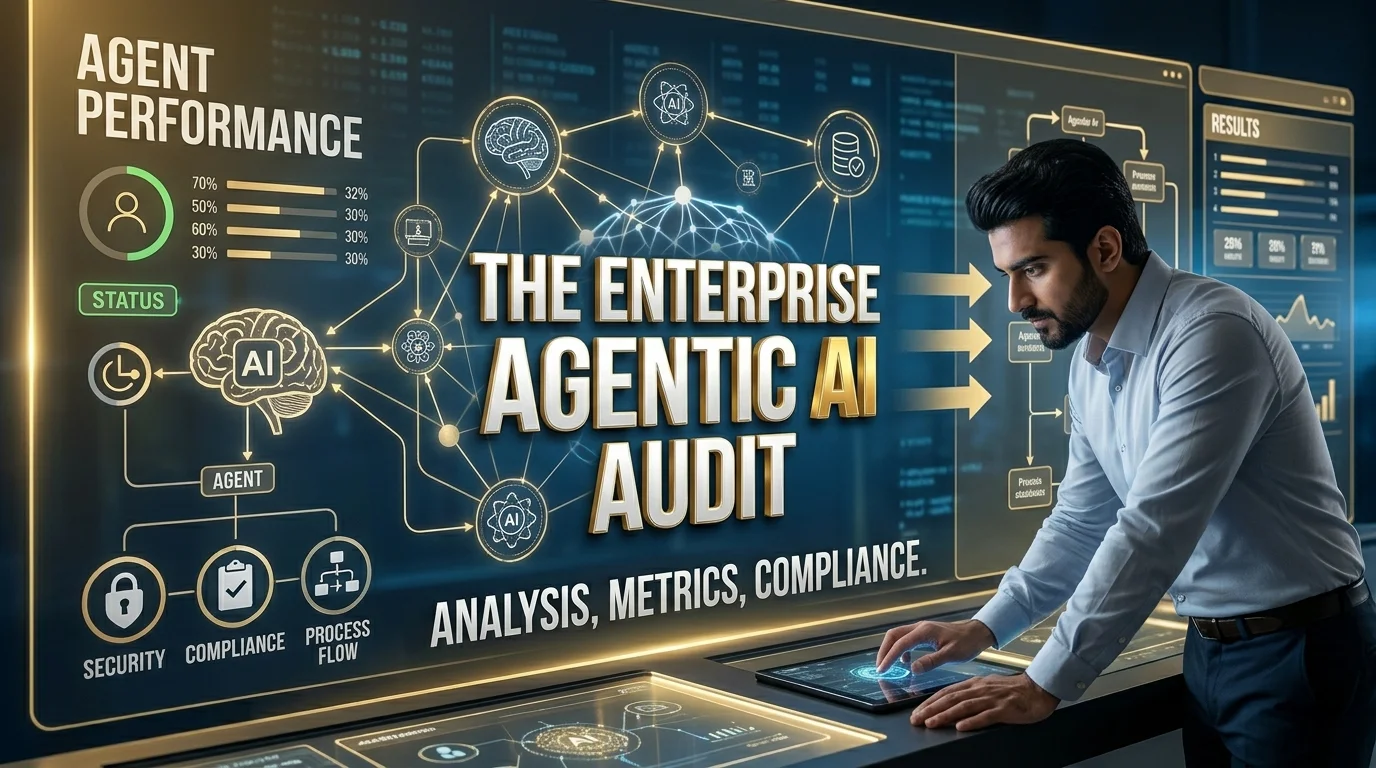
As of April 2026, the enterprise landscape has moved past the initial excitement of “Generative AI” and entered a period of rigorous scrutiny. The Enterprise Agentic AI Audit reflects a market where 40% of enterprise applications now embed task-specific agents, yet a significant “value gap” remains between pilot projects and production-grade ROI.
1. What Is Working: The “High-Yield” Wins
Success in 2026 is defined by autonomous orchestration agents that don’t just “chat,” but execute multi-step business logic across disconnected systems.
Closed-Loop Sales & Support: Large-scale deployments, such as those by Salesforce and EY, are now handling tens of thousands of weekly conversations with resolution rates exceeding 80%. These agents autonomously process refunds, validate margin requirements, and trigger fulfillment without human intervention.
Self-Correcting Code & DevOps: Frameworks like smolagents and LangGraph have moved from experimental to mainstream. By using recursive reasoning (where the agent runs code, identifies errors, and “reflects” to rewrite the solution), success rates for automated technical tasks have jumped from roughly 54% to over 81%.
Predictive Operations: In supply chain and manufacturing, agents are monitoring real-time data from IoT sensors to proactively reschedule production or reroute logistics. This “decision-intelligence” is significantly reducing the $14,000-per-minute cost of downtime for mid-market firms.
2. What Is Not: The Scaling Bottlenecks
Despite the wins, a “Great AI Stall” is affecting nearly 70% of organizations. Recent audits reveal several persistent failures:
The “Agent Washing” Trap: Gartner warns that many vendors have simply rebranded basic chatbots or RPA scripts as “agents.” These systems lack the reasoning depth to follow nuanced, long-term instructions, leading to project cancellations due to “unclear business value.”
Data Fragmentation & Quality: Over 50% of businesses cite data readiness as their primary barrier. Agents are only as effective as the context they can access; when data is siloed in legacy ERPs or inconsistent spreadsheets, the agent’s “reasoning” becomes brittle and unreliable.
The Compounding Error Rate: In multi-agent systems, a tiny 1% error in the first agent can compound into a total system failure by the fifth step. Without “human-in-the-loop” approval gates at critical decision points, these autonomous chains often drift into costly hallucinations.
3. What Comes Next: The 2027 Roadmap
The next phase of the audit focuses on moving from “individual task augmentation” to “systemic productivity.”
Agentic Orchestration Platforms: We are seeing a shift toward centralized frameworks (like Monday.com’s agentic ecosystems or EY.ai Agentic for Sales) that provide built-in governance, audit logs, and permission boundaries. The goal is to move from 150 disconnected “simple agents” to a single, governed “orchestrator.”
Industry-Specific Clouds: Generic models are being replaced by “Industry-Scale Agentic AI.” These platforms come pre-configured with the regulatory and compliance guardrails necessary for finance, healthcare, and audit services, drastically reducing the time-to-production.
Focus on TCO and ROI: By the end of 2027, Gartner predicts that over 40% of current agentic projects will be canceled. The survivors will be those that prioritize Total Cost of Ownership (TCO) focusing only on use cases where an autonomous agent provides a measurable increase in speed, quality, or scale compared to traditional automation.
The Audit Verdict
The “experimental phase” of Agentic AI is over. In 2026, the organizations winning the audit are those that treat AI agents as digital co-workers rather than just smarter software. They are investing in “data molecules” that carry their own context and governance, ensuring that as AI gains autonomy, it remains safe, transparent, and aligned with the bottom line.
Conclusion:
In conclusion, the Enterprise Agentic AI Audit of 2026 confirms that we have reached a “production-first” baseline where autonomy is no longer a luxury, but a competitive requirement. While 42% of organizations have successfully moved agents into core workflows, the divide between leaders and laggards is defined by data readiness and governance.