Introduction:
Building an artificial intelligence agent is vastly different from traditional software development. Unlike rigid applications that follow predefined, step-by-step logic, AI agents are designed to reason, select tools, maintain long-term memory, and execute complex workflows autonomously.
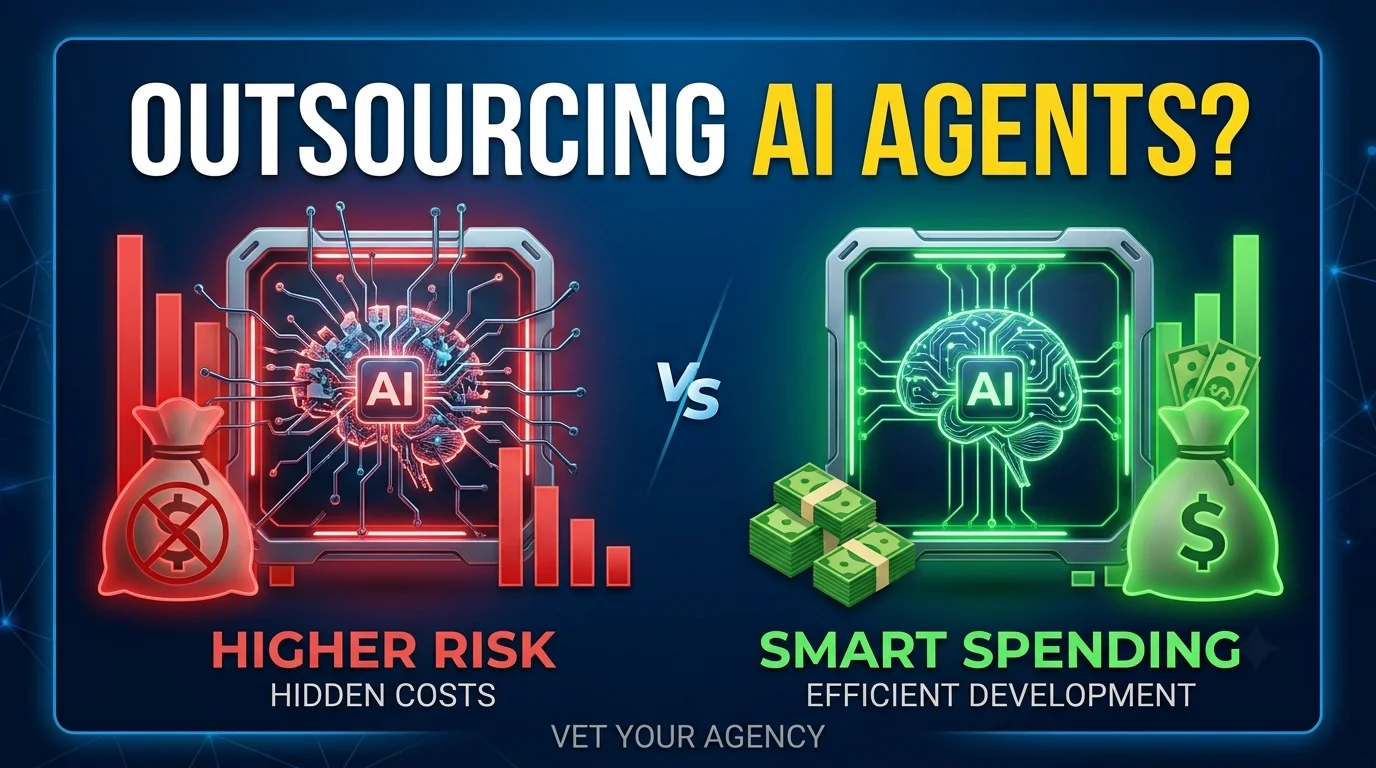
Because building an internal team of AI engineers, data scientists, and infrastructure specialists can quickly cost between $250,000 and $600,000 annually, outsourcing has become an essential strategy for companies looking to deploy agentic technology rapidly and cost-effectively. However, handing over the keys of autonomous decision-making software to an external partner comes with distinct trade-offs.
The Pros of Outsourcing AI Agent Development
Outsourcing offers distinct strategic advantages, particularly for organizations looking to validate an AI strategy without uprooting their existing operational structure.
1. Instant Access to Specialized, Rare Talent
The global shortage of experienced machine learning and prompt engineers means that recruiting an internal team can take months. Outsourcing firms maintain dedicated, pre-vetted teams who live and breathe specific AI infrastructure every day, from vector databases to orchestration frameworks like LangGraph or AutoGen.
2. Drastically Reduced Upfront Capital and Infrastructure Costs
Building internally requires hefty continuous investments in data labeling pipelines, powerful specialized developer workstations, and cloud computing sandbox environments.
Specialized development agencies already possess this infrastructure, absorbing the overhead costs into project-based pricing. This makes a custom Proof of Concept (PoC) accessible for roughly $15,000 to $35,000, and a production-ready Minimum Viable Product (MVP) agent achievable for $25,000 to $60,000.
3. Accelerated Time-to-Market
Speed is an absolute competitive necessity. Because external agencies rely on reusable modular logic layers, pre-built security guardrails, and structured retrieval-augmented generation (RAG) pipelines, they can routinely design, test, and deploy a fully functional workflow automation agent within a concise 6 to 12-week timeframe.
The Cons of Outsourcing AI Agent Development
While the financial and speed metrics are highly attractive, handing autonomous workflows over to external entities introduces nuanced operational liabilities.
1. The Risk of Long-Term Vendor Lock-In
If an outsourcing agency builds your agent utilizing proprietary internal wrappers or highly complex, undocumented custom code, your company becomes entirely dependent on them for every subsequent modification. If the agency raises its rates or shifts priorities, you may be left with a highly complex “black box” that your internal IT staff cannot fix, update, or properly audit.
2. Integration and Cultural Friction
An AI agent is only as effective as the data it accesses and the software systems it controls. External agencies often struggle to understand the messy, undocumented realities of an organization’s legacy internal databases, customer relationship management (CRM) systems, or enterprise resource planning (ERP) software, leading to extended implementation timelines and unexpected integration costs.
3. Escalating Running and Maintenance Costs
Many organizations mistakenly assume that the project’s delivery invoice represents the final cost. AI agents require active, ongoing maintenance. Models drift as data evolves, external system APIs change, and token usage fees fluctuate based on traffic volume.
Ongoing monitoring and optimization usually add a recurring annual cost equivalent to 15% to 30% of the initial build budget. If the outsourcing agreement doesn’t clearly define who handles this maintenance, operational costs can spiral.
What to Watch Out For (The Crucial Guardrails)
If you decide to partner with an external development firm, success depends heavily on implementing aggressive, proactive governance safeguards from day one.
1. Data Security and Regulatory Compliance
AI agents require deep access to internal documentation, product data, and often sensitive customer information. You must verify exactly how the vendor plans to sanitize this data. Ensure they have explicit protocols for stripping out personally identifiable information (PII) before it reaches public LLM APIs. Demand field-level redaction, signed transaction logs, and clear data residency guarantees to remain compliant with regional data protection acts.
2. Model Evaluation and Rigorous Edge-Case Testing
Unlike a traditional mobile app, an AI agent can behave unpredictably when faced with novel user queries or messy data inputs. Watch out for vendors who rely solely on manual, ad-hoc testing. Ensure your partner uses rigorous automated evaluation frameworks to explicitly stress-test the agent against adversarial prompts, hallucinations, and hidden biases before pushing it to a live production environment.
3. Deep Architectural Control and Intellectual Property
Maintain strict ownership of your intellectual property. Your contract should explicitly state that your company owns the complete custom code, data embeddings, and specific system prompts. Require the outsourcing agency to build using standardized, well-documented open-source frameworks rather than obscure, closed architecture. This ensures that if you eventually choose to hand operations over to an internal team, the transition is seamless.
The Operational Rule of Thumb: Use outsourcing to rapidly build, test, and prove the concrete business value of your AI agent. However, as that agent scales to automate business-critical systems or handle high-volume customer interactions, prioritize building internal capability to monitor its performance, manage security permissions, and guide its long-term development.
Conclusion:
Outsourcing AI agent development serves as an excellent accelerator, allowing businesses to bypass high hiring overhead and deploy sophisticated autonomous systems in weeks rather than months. However, the speed and cost benefits only hold true if guarded by strict technical governance.
To prevent vendor lock-in and operational disruption, organizations must maintain absolute ownership of their intellectual property, insist on open-source orchestration frameworks, and implement rigorous data sanitization protocols. Ultimately, the most successful approach uses external expertise to rapidly build and validate the application, while gradually developing internal capabilities to manage and audit the AI as it scales.