Introduction:
The cost of developing a food ordering website in 2026 relies on a major shift in technology: the move away from monolithic, hard-coded structures toward modular, composable architecture driven by headless technology and localized AI optimization. Rather than simply calculating the cost of coding pages, modern pricing is dictated by how seamlessly a website connects to real-time supply chains, third-party delivery fleets, and autonomous kitchen systems.
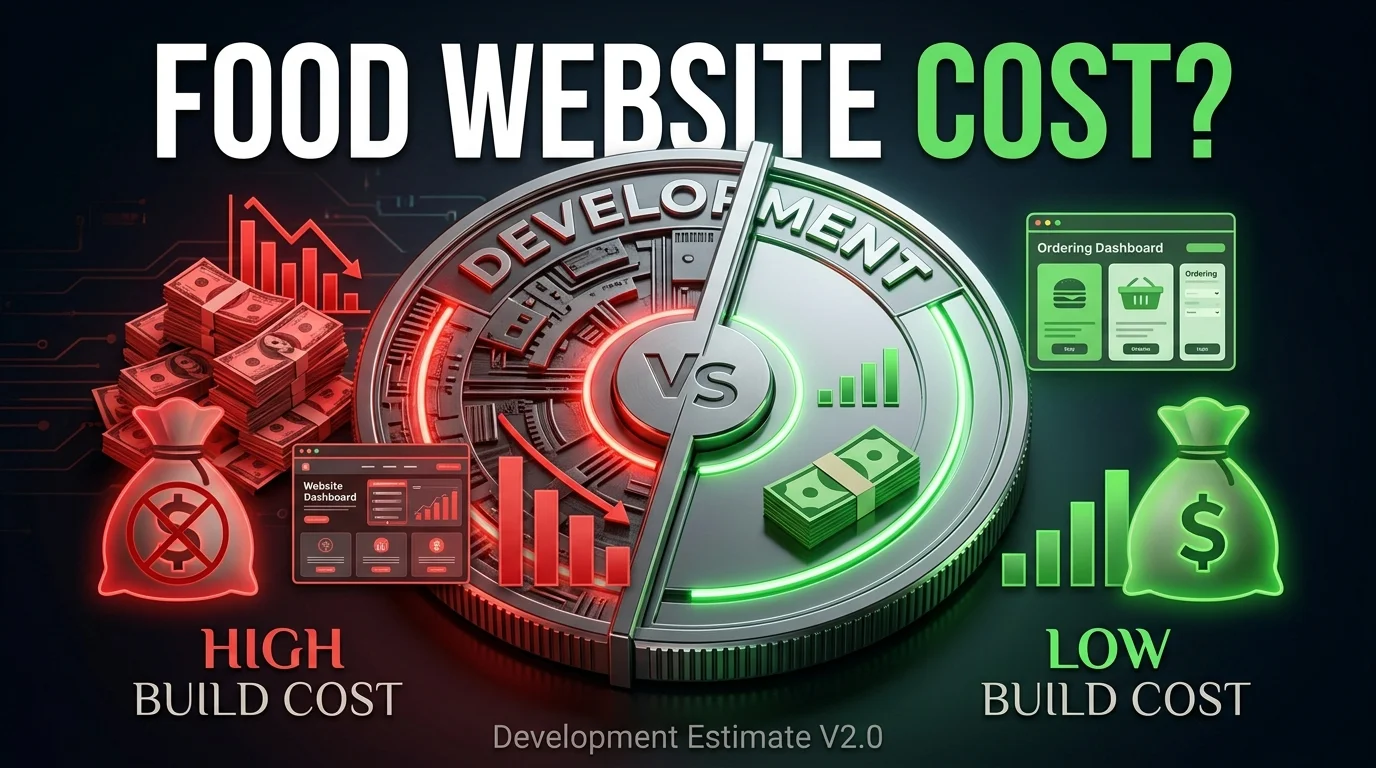
To establish an immediate baseline, a custom food ordering website in 2026 typically starts at $8,000 for a highly focused single-location setup, while a fully integrated enterprise-level marketplace can easily exceed $120,000.
Direct Cost Projections by Scale
To analyze how budgets distribute across different business models, the marketplace splits into three distinct architectural categories.
1. The Headless Micro-Storefront
Designed for independent restaurants or boutique food brands that want total control over their data and brand identity without building everything from scratch.
Cost Spectrum: $8,000 to $18,000.
Unique 2026 Blueprint: These sites leverage a “headless” setup, separating the visual frontend from the backend commerce engine. This ensures the website loads instantly on mobile devices, even on slower cellular networks, and integrates directly with local point-of-sale systems without expensive custom middleware.
2. Multi-Brand Regional Platforms and Virtual Hubs
Built for franchise groups, cloud kitchen networks, or regional brands managing multiple distinct culinary concepts out of shared commercial spaces.
Cost Spectrum: $22,000 to $55,000.
Unique 2026 Blueprint: The core expense here lies in automated order routing. The system must dynamically assess kitchen capacity, ingredient availability across locations, and proximity to active courier clusters, instantly directing the order to the most efficient preparation hub.
3. Hyper-Local Autonomous Marketplaces
Next-generation aggregator networks where independent merchants register, manage virtual storefronts, and tap into decentralized delivery ecosystems.
Cost Spectrum: $60,000 to $140,000+.
Unique 2026 Blueprint: These platforms require three deeply integrated interfaces: an adaptive consumer web-app, a high-throughput merchant control panel, and a logistics dispatch layer. The premium cost stems from building high-concurrency architectures that can handle thousands of simultaneous checkout attempts during peak hours without latency spikes.
Unique Factors Shaping Budgets in 2026
The economics of web development have shifted. Traditional components like basic databases have become highly commoditized, while specialized, real-time integration layers now command the premium share of the budget.
1. Composable “API-First” Architecture
Modern websites are rarely built as single, massive blocks of code. Instead, developers assemble platforms using specialized APIs. While this prevents long-term vendor lock-in, it requires highly skilled software engineers to orchestrate the backend smoothly. Connecting custom menus to decentralized, on-demand courier networks requires building robust asynchronous data pipelines, which increases initial engineering costs.
2. Contextual AI and Dynamic Menu Generation
Basic static menus are a thing of the past. High-converting 2026 storefronts use lightweight, privacy-compliant machine learning models right in the browser. The system analyzes real-time external signals just like hyper-local weather patterns, current kitchen preparation speeds, and time-of-day traffic to dynamically rearrange menu items and maximize high-margin sales. Implementing these automated optimization layers generally adds a distinct premium to the initial build.
3. Hyper-Frictionless Checkout and Identity Layers
Cart abandonment remains a massive challenge for online food ordering. Premium budgets dedicate significant resources to building native passkey authentication and biometric checkouts, completely eliminating the need for traditional usernames and passwords. Designing these secure, single-tap checkout loops requires specialized security compliance testing and extensive front-end optimization across mobile browsers.
Hidden Post-Launch Financial Variables
The total investment required extends well beyond the initial deployment date. Maintaining a competitive, secure digital storefront requires ongoing operational capital.
API Consumption Overhead: Modern food websites rely on a web of paid microservices. Every automated address verification, maps API call, real-time tracking update, and SMS confirmation incurs fractional transaction costs that scale alongside order volume.
Edge Hosting and Content Delivery Infrastructure: To guarantee fast page loads, websites are hosted on edge networks that serve files from servers physically closest to the user. While highly efficient, managing these distributed cloud setups during high-traffic lunch and dinner rushes requires dedicated infrastructure optimization.
Architectural Maintenance and Security Governance: Securing financial transactions and user data requires continuous vulnerability scanning and regular security updates. Businesses should budget roughly 20% of their original development costs annually to handle required system updates, browser compliance, and ongoing optimization.
The 2026 Strategic Takeaway: The most cost-effective path to market is avoiding over-engineering on day one. Prioritize your budget around a high-performance frontend and a secure checkout flow. By launching a lean, highly optimized Minimum Viable Product (MVP), you can validate your local market and fund advanced automation features directly through your operational cash flow.
Conclusion:
Meanwhile, the cost of developing a food ordering website in 2026 is no longer defined by the number of pages built, but by how intelligently the platform integrates into the real-time food ecosystem. Shifting toward modular, composable architectures and lightweight AI personalization allows modern storefronts to operate with unprecedented speed and efficiency, though it requires a higher upfront technical investment.
By prioritizing a high-performance, frictionless mobile frontend and launching with a focused MVP, businesses can successfully bypass predatory third-party aggregator fees, retain complete ownership of their customer data, and secure a sustainable long-term return on investment.