Introduction:
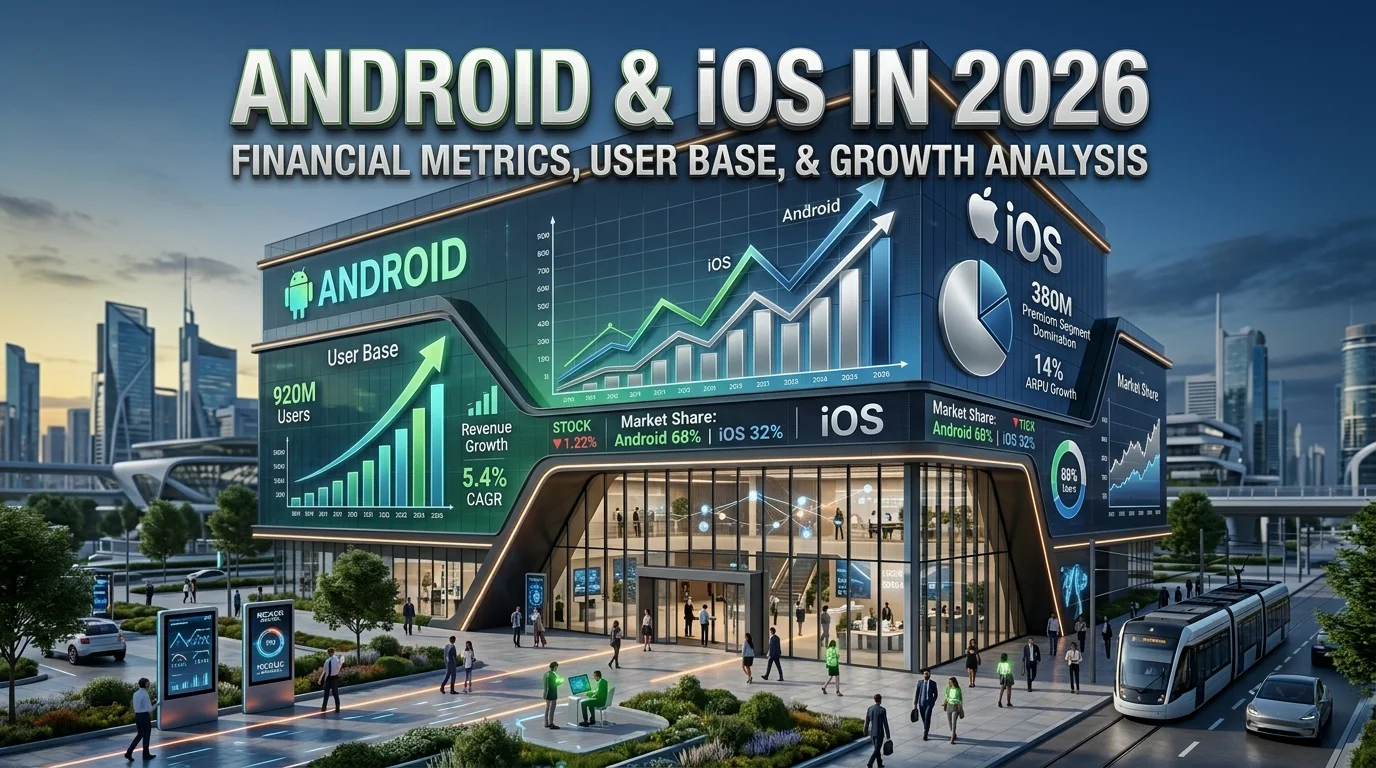
In 2026, the rivalry between Android and iOS has solidified into a stable “duopoly of extremes.” While Android maintains a massive lead in raw volume and accessibility, iOS continues to dominate the high-value, high-revenue segments of the market.
Below is a detailed discussion of the market dynamics, usage statistics, and revenue trends defining this year.
Global Market Share: The Volume vs. Value Divide
The divide in market share has remained remarkably consistent, with Android capturing the vast majority of global users through its open-source versatility and range of hardware price points.
Global Distribution: Android holds approximately 71% to 73% of the global market share. iOS accounts for the remaining 27% to 29%.
Active User Base: There are now an estimated 3.9 to 4.5 billion active Android devices worldwide, compared to roughly 1.46 to 1.56 billion active iPhone users.
Regional Strongholds: * iOS Dominance: In the United States and Japan, iOS remains the leader, holding roughly 58% and 69% of the market, respectively.
Android Dominance: In emerging and high-population markets like India and Africa, Android’s share exceeds 90%, driven by the availability of high-quality, budget-friendly hardware.
Revenue and Spending: The Economic Gap
While Android wins on sheer numbers, the “revenue gap” between the two platforms has actually widened in 2026. This is the single most critical factor for developers and businesses.
App Store Revenue: The Apple App Store is projected to generate over $161 billion in consumer spend this year, capturing nearly 68% of the total global mobile app revenue.
Google Play Revenue: Despite having nearly triple the user base, Google Play revenue is projected at $72 billion.
Spending Habits: The average iOS user spends approximately $10.40 per month on apps and in-app purchases, whereas the average Android user spends about $1.40. Essentially, a single iOS user is worth roughly seven times more than an Android user in terms of direct monthly digital spend.
Subscription Power: iOS accounts for 73% of all mobile subscription revenue, making it the primary target for SaaS and content-streaming businesses.
Demographics and User Behavior
The choice of operating system has become a significant indicator of demographic trends, particularly in Western markets.
The Gen Z Factor: In the U.S., a staggering 87% of teenagers own an iPhone. This indicates that Apple’s ecosystem driven by iMessage, FaceTime, and the Vision Pro integration that has created a powerful “social lock-in” for the next generation of consumers.
Education and Income: Statistically, iOS users are 55% more likely to hold a college degree and have a higher average annual income (approx. $85,000) compared to Android users (approx. $61,000).
Engagement Levels: iPhone users are generally more active on their devices, averaging 5 hours of screen time per day, compared to 3.7 hours for Android users.
Emerging Trends for 2026
The Generative AI War: Both platforms have deeply integrated AI at the OS level. While Apple’s “Apple Intelligence” focuses on privacy-first, on-device automation, Google’s Gemini has become the gold standard for creative assistance and cloud-integrated search, giving Android a slight edge in “utility” tools.
Environmental Impact: A new trend in 2026 is the rise of the “Refurbished Market.” Roughly 31% of smartphone buyers now prioritize environmental impact, leading to record-high sales for refurbished iPhones, which retain their value significantly longer than Android counterparts.
Hardware Evolution: Foldable devices have finally moved past the “early adopter” phase, growing 30% year-over-year. Currently, Android dominates this niche (led by Samsung and Google), as Apple has yet to release a mass-market foldable iPhone.
Conclusion
For a business in 2026, the platform choice depends entirely on the goal. If the objective is scale and reach (e.g., social media or utility apps), Android is the essential foundation. However, if the goal is monetization and high-lifetime-value customers (e.g., gaming, professional tools, or luxury retail), iOS is the undisputed leader.
Most major firms now utilize a “simultaneous launch” strategy to capture the best of both worlds.