Introduction:
In the infrastructure of 2026, the transition from IPv4 to IPv6 has moved from a “future goal” to a technical necessity. As the Internet of Things (IoT) and 6G networks expand, the limitations of the older protocol have become increasingly visible.
Below is a detailed discussion of the fundamental differences between these two versions of the Internet Protocol.
1. Address Space and Capacity
The most significant difference lies in the sheer volume of available addresses.
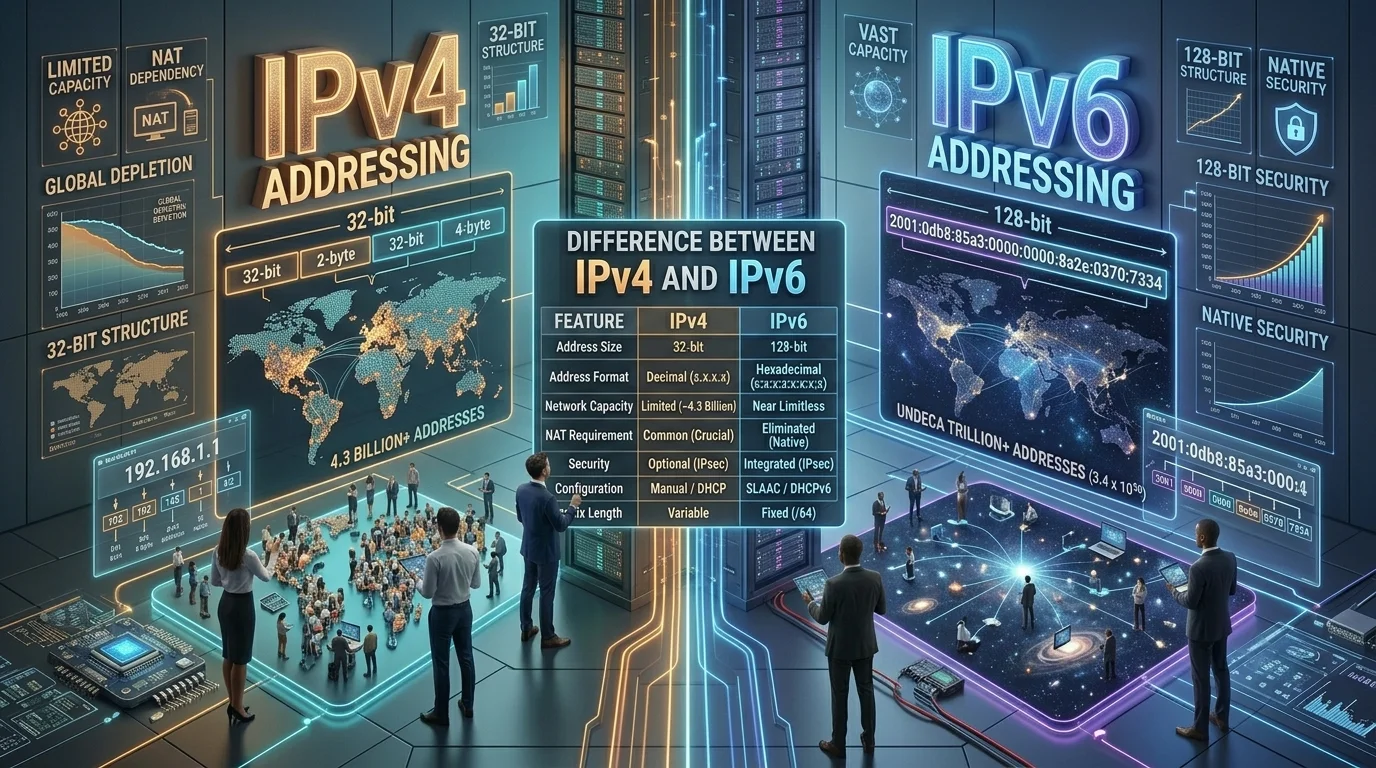
IPv4 uses a 32-bit address scheme, which limits the total number of unique addresses to approximately 4.3 billion. In the early days of the internet, this seemed infinite; however, with the explosion of smartphones, smart homes, and industrial sensors, these addresses were officially exhausted years ago.
IPv6 utilizes a 128-bit address scheme. This provides a staggering $3.4 \times 10^{38}$ addresses (340 undecillion). To put this in perspective, IPv6 can provide enough unique IP addresses for every grain of sand on Earth to have its own connection, ensuring the internet can grow indefinitely.
2. Address Notation and Formatting
The way these addresses are written and read by humans and machines differs significantly.
IPv4 addresses are represented in dotted-decimal notation, consisting of four octets separated by dots (e.g., 192.168.1.1).
IPv6 addresses are written in hexadecimal notation and separated by colons (e.g., 2001:0db8:85a3:0000:0000:8a2e:0370:7334). Because these addresses are long, the protocol allows for “zero compression” (using double colons ::) to make them more manageable.
3. Configuration and Management
How a device actually gets its “identity” on a network has been simplified in the newer version.
In an IPv4 environment, devices usually require a DHCP server (Dynamic Host Configuration Protocol) to assign an IP address, or they must be configured manually (Static IP).
IPv6 supports Stateless Address Autoconfiguration (SLAAC). This allows a device to generate its own unique IP address as soon as it connects to a network by using its MAC address and information from the local router. This “plug-and-play” capability is essential for the billions of IoT devices active in 2026.
4. Packet Header Complexity and Efficiency
The “envelope” that carries data across the web has been redesigned for better performance in IPv6.
IPv4 headers are of variable length and include a “checksum” that must be recalculated by every router the packet passes through. This adds a small amount of latency at every “hop” in the journey.
IPv6 uses a fixed-length header (40 bytes). It removes the header checksum, shifting error-handling to other layers of the network. This allows modern high-speed routers to process packets much faster, which is critical for 2026’s ultra-low latency requirements in autonomous driving and remote surgery.
5. Security and Quality of Service (QoS)
Security was an afterthought in the 1980s but is foundational today.
IPv4 was designed without built-in security. IPsec (Internet Protocol Security) was developed later and is an optional add-on that must be configured.
IPv6 was built with IPsec integration as a core requirement. While not every connection uses it, the protocol was designed to support end-to-end encryption and authentication natively. Furthermore, IPv6 includes a “Flow Label” field that allows routers to identify and prioritize sensitive traffic (like a Zoom call or a VR stream) more effectively than IPv4.
The 2026 Perspective: Dual-Stack Reality
While IPv6 is superior in every technical metric, IPv4 has not disappeared. Most networks currently operate in a “Dual-Stack” mode, where both protocols run simultaneously.
However, as the cost of “renting” rare IPv4 addresses continues to rise, more businesses are moving toward IPv6-only internal networks, using translation technologies to communicate with the older parts of the web. The shift is no longer about “if” but about how quickly an organization can shed the legacy constraints of IPv4.