Introduction:
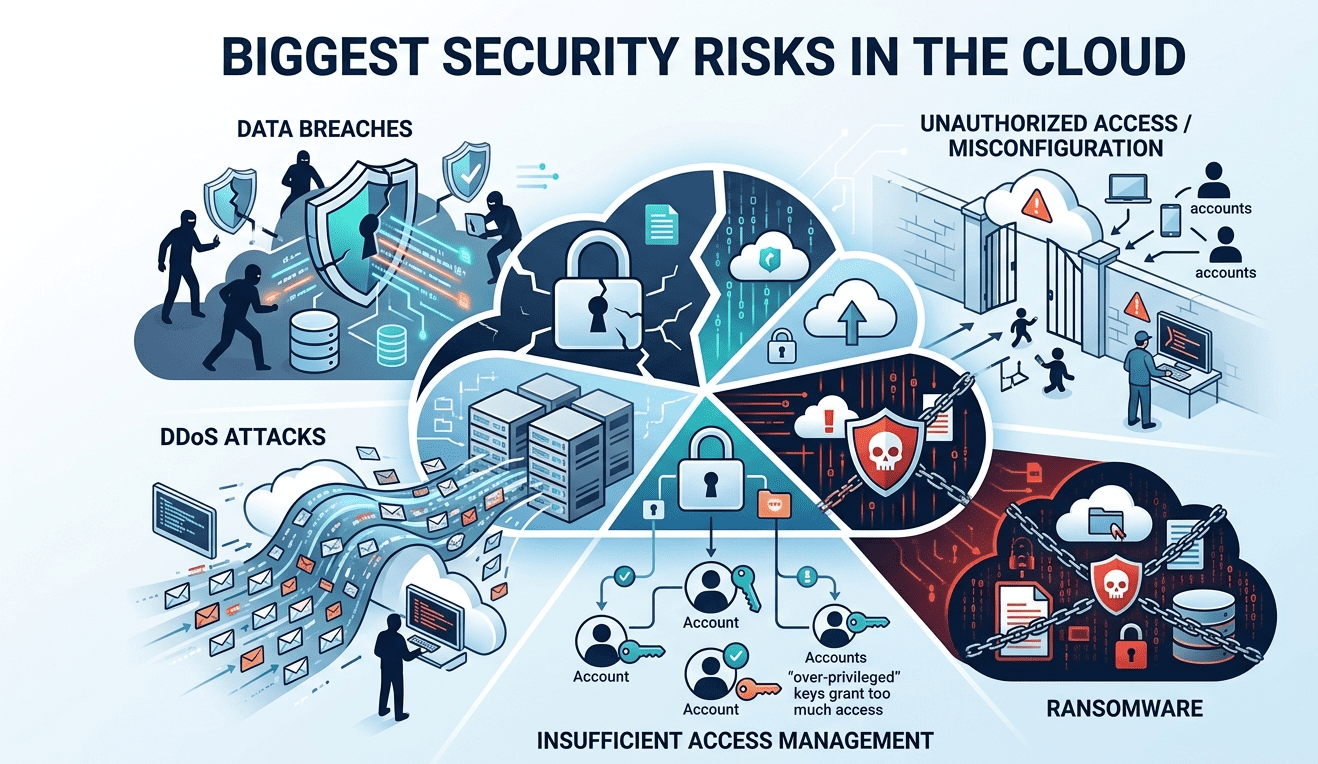
As organizations move from simple storage to complex, AI-driven ecosystems, the nature of cloud risk has shifted. In 2026, the primary threats are no longer just about “losing data,” but about the speed at which automated systems can be weaponized against a network.
1. The Non-Human Identity (NHI) Explosion
In modern cloud architectures, machine identities, such as service accounts, API keys, and autonomous AI agents now outnumber human users by as much as 100-to-1.
The Risk: Unlike human employees, these non-human identities often lack clear ownership and are frequently over-privileged. Because they operate at machine speed, a single compromised API token can allow an attacker to exfiltrate massive datasets in seconds, long before a human analyst can intervene.
The Shift: Security is moving away from protecting “logins” and toward governing the “identity fabric” that connects these microservices.
2. AI-Powered “Machine-Speed” Attacks
The emergence of Agentic AI has created a new arms race. Threat actors now use generative AI to automate the entire attack lifecycle, from initial reconnaissance to exploit generation.
High-Velocity Breach: Breakout times (the time it takes for an attacker to move from an initial entry point to other parts of the network) have dropped significantly, with some eCrime groups achieving lateral movement in under 30 minutes.
Deepfake Social Engineering: Attackers are using AI-driven voice and video cloning to impersonate executives or IT help desk staff (vishing), tricking employees into bypassing Multi-Factor Authentication (MFA) or resetting high-level credentials.
3. The “Toxic Trilogy” of Cloud Exposure
Many breaches in 2026 are not caused by complex zero-day exploits, but by a “toxic” combination of three preventable factors:
- Misconfigurations: Publicly exposed storage buckets or improperly secured API endpoints.
- Excessive Permissions: Giving a simple application “Administrator” level access to the entire cloud environment.
- Vulnerable Workloads: Running unpatched or legacy software within a containerized environment.
When these three overlap, they create an “attack path” that allows a low-level breach to escalate into a full-scale corporate disaster.
4. Supply Chain and “Vibe Coding” Risks
The push for productivity has led to “vibe coding”, that is the practice of using AI tools to quickly generate and integrate code with minimal technical scrutiny.
Slop Code: Developers may inadvertently include “slop code” (suboptimal or insecure AI-generated components) that contains hidden backdoors or vulnerabilities.
API Cascades: Because modern cloud apps are a web of third-party integrations, a single vulnerability in a popular upstream plugin can “cascade” down, affecting thousands of businesses that use that specific integration.
5. Geopatriation and Sovereignty Conflicts
As global regulations tighten, where your data lives has become a major security risk.
Regulatory Fragmentation: Different regions (EU, North America, Asia-Pacific) now have conflicting laws regarding data residency and processing.
The Risk: Organizations operating across multiple clouds often experience “policy drift,” where security settings in one region don’t match another. This inconsistency leads to compliance failures and “blind spots” that attackers exploit to move silently between regional tenants.
Conclusion:
The modern cloud landscape is a double-edged sword: it offers unprecedented scale and innovation, but it also introduces a highly automated and complex attack surface. Security in 2026 is no longer just about building a perimeter; it is about managing the “identity fabric” of both human and AI agents and ensuring that misconfigurations don’t create an open door for machine-speed exploits.
Meanwhile, staying secure requires a shift from a reactive mindset to a proactive, “Zero Trust” architecture. By prioritizing visibility, enforcing the principle of least privilege, and conducting regular audits, organizations can leverage the power of the cloud without falling victim to its inherent risks.